🔴 Latest Update:
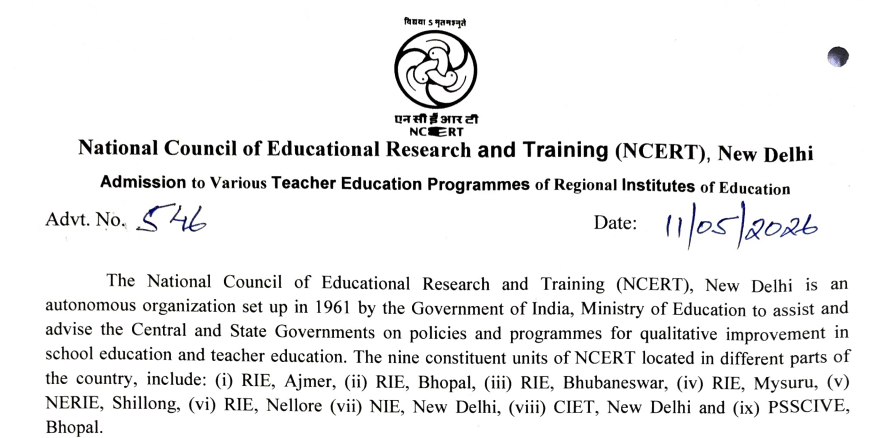
12 May 2026: NCERT has officially released the RIE CEE 2026 notification for admission to teacher education programmes at all Regional Institutes of Education. Online application starts from 15 May 2026 at cee.ncert.gov.in. The CEE 2026 exam will be conducted on 28 June 2026 (Sunday). Programmes available: Integrated B.Sc. B.Ed. / B.A. B.Ed. (Group A), B.Ed. / B.Ed.–M.Ed. / M.A. Education Technology (Group B), and M.Ed. (Group C) at RIE Ajmer, Bhopal, Bhubaneswar, Mysuru, Shillong and other NCERT institutions. Application last date: June 2026 (confirm on portal).
NCERT RIE Admission 2026 is conducted through the Common Entrance Examination (CEE) 2026 by the National Council of Educational Research and Training (NCERT). This is a prestigious national-level entrance examination for admission to high-quality teacher education programmes at five Regional Institutes of Education (RIEs) located in Ajmer, Bhopal, Bhubaneswar, Mysuru, and Shillong — and other NCERT institutions including NIE New Delhi, CIET New Delhi, NERIE Shillong, and PSSCIVE Bhopal.
The RIE CEE 2026 application process begins on 15 May 2026 at cee.ncert.gov.in, and the examination is scheduled on 28 June 2026 (Sunday). Results are expected in August/September 2026, followed by counselling and admission to the 2026-27 academic session.
NCERT RIE Admission 2026 – Overview
| Detail | Information |
|---|---|
| Conducting Body | National Council of Educational Research and Training (NCERT) |
| Exam Name | Common Entrance Examination (CEE) – 2026 |
| Short Name | RIE CEE 2026 |
| Official Admission Website | cee.ncert.gov.in |
| NCERT Official Website | ncert.nic.in |
| Application Start Date | 15 May 2026 |
| Application Last Date | June 2026 (exact date on portal — confirm at cee.ncert.gov.in) |
| Application Mode | Online only — at cee.ncert.gov.in |
| Application Fee (General/OBC/EWS) | ₹1,000 |
| Application Fee (SC/ST/PwD) | ₹500 |
| CEE Exam Date | 28 June 2026 (Sunday) |
| Exam Mode | Offline (Pen & Paper / OMR based) |
| Total Marks | 160 (80 questions × 2 marks each) |
| Negative Marking | -0.5 per wrong answer |
| Admit Card | 2–4 days before exam (check cee.ncert.gov.in) |
| Result | August / September 2026 (tentative) |
| Counselling | After result declaration |
| Programmes | Group A, Group B, Group C |
| Tie-Breaking | 60% CEE score + 40% qualifying exam marks |
| Single Application for Multiple Programmes | Yes — single registration, single payment |
| Helpline Number | 022-61306271 (Mon–Fri, 10 AM–5 PM) |
NCERT RIE Admission 2026 – Important Dates
| Event | Date |
|---|---|
| Notification Released | March–April 2026 |
| Application Form Starts | 15 May 2026 |
| Application Last Date | June 2026 (confirm at cee.ncert.gov.in) |
| Application Fee Payment Last Date | Same as application last date |
| Application Correction Window | After last date (if opened by NCERT) |
| Admit Card Download | 2–4 days before exam |
| CEE Exam Date | 28 June 2026 (Sunday) |
| Answer Key Release | July 2026 (tentative) |
| Result Declaration | August / September 2026 |
| Merit List | After result |
| Counselling / Option Entry | September 2026 (tentative) |
| Admission Session | 2026–27 |
Note: NCERT might change the dates on their website. Always check at cee.ncert.gov.in before applying. The last date to apply will be clearly mentioned on the website when the form is available, on 15 May 2026.
NCERT RIE CEE 2026 vs NCET 2026 — Critical Difference
This is the most confusing point for aspirants — and no competitor properly explains this:
| Feature | RIE CEE 2026 | NCET 2026 |
|---|---|---|
| Full Name | Regional Institute of Education Common Entrance Examination | National Common Entrance Test |
| Conducted By | NCERT | NTA (National Testing Agency) |
| For Admission To | B.Sc. B.Ed., B.A. B.Ed., B.Ed., M.Ed., B.Ed.–M.Ed. at RIEs | 4-Year Integrated Teacher Education Programme (ITEP) at Central Universities and selected institutions |
| Programme Type | B.Sc. B.Ed. (4-yr), B.A. B.Ed. (4-yr), B.Ed. (2-yr), M.Ed. (2-yr), B.Ed.–M.Ed. (3-yr) | 4-Year ITEP only |
| Exam Date 2026 | 28 June 2026 | As per NTA schedule |
| Apply At | cee.ncert.gov.in | ncet.samarth.edu.in |
| Eligible For | 12th pass (Group A) / Graduates (Group B) / B.Ed. holders (Group C) | 12th pass (for ITEP) |
To get into the 4-Year ITEP programme at RIEs, which’s a new programme from the NEP 2020 you need to apply through the NCET 2026 which is run by the NTA. Do not apply through the RIE CEE. The RIE CEE 2026 is for people who want to join the B.Sc. B.Ed.. The B.A. B.Ed.. The B.Ed.. The M.Ed.. The B.Ed.–M.Ed. Programme. The 4-Year ITEP programme, at RIEs is different. You have to apply for it through the NCET 2026.
NCERT RIE Admission 2026 – All Programmes (Group A, B, C)
NCERT RIE CEE 2026 covers three groups of programmes:
Group A — Integrated UG+PG Teacher Education (For Class 12 Pass Candidates)
| Programme | Duration | Qualifying Exam | Min Marks |
|---|---|---|---|
| Integrated B.Sc. B.Ed. | 4 Years | Class 12 with PCM or PCB | 50% (45% SC/ST/PwD) |
| Integrated B.A. B.Ed. | 4 Years | Class 12 in any stream | 50% (45% SC/ST/PwD) |
| Integrated M.Sc. Ed. | 6 Years | Class 12 with Science/Maths | 50% (45% SC/ST/PwD) |
The programmes in Group A will give you two things when you finish. You will know a lot about the subject you studied for your undergraduate degree. You will also learn how to be a teacher. You can get all this in four years. If you want to do a Master of Science in Education it will take six years.
This is really good for students who have just passed Class 12. They want to teach a subject to students at the secondary level. Group A programmes are perfect, for these students because they give you the knowledge you need and also teach you how to teach that subject to others.
Group B — B.Ed. and Allied PG Programmes (For Graduates)
| Programme | Duration | Qualifying Exam | Min Marks |
|---|---|---|---|
| B.Ed. (Bachelor of Education) | 2 Years | Graduation in any stream | 50% (45% SC/ST/PwD) |
| Integrated B.Ed.–M.Ed. | 3 Years | Graduation | 50% (45% SC/ST/PwD) |
| M.A. Education Technology | 2 Years | Graduation | 50% (45% SC/ST/PwD) |
The Bachelor of Education degree from the National Council of Educational Research and Training Regional Institute of Education is one of the respected teacher education qualifications in India. This degree is recognized by the National Council for Teacher Education.
It is accepted for teaching jobs in Kendriya Vidyalaya Sangathan, Navodaya Vidyalaya Samiti, Sainik Schools, Army Schools and all the central government school systems. The Bachelor of Education degree, from the National Council of Educational Research and Training Regional Institute of Education is really valuable.
Group C — M.Ed. Programme (For B.Ed. Holders)
| Programme | Duration | Qualifying Exam | Min Marks |
|---|---|---|---|
| M.Ed. (Master of Education) | 2 Years | B.Ed. or equivalent | 50% (45% SC/ST/PwD) |
If you get a Master of Education degree from the National Council of Educational Research and Training Regional Institute of Education you can be a teacher educator in colleges that offer Bachelor of Education degrees and in education departments. Having this degree also makes you eligible to get a Doctor of Philosophy, in Education degree.
NCERT RIE Admission 2026 – Eligibility Criteria (Group-wise)
NCERT RIE Admission 2026 has some rules for people who want to join.
For people who want to do B.Sc. B.Ed.. B.a. B.Ed.. M.sc. Ed., which’s Group A they need to pass Class 12 first.
To get into NCERT RIE Admission 2026 people need to pass Class 12 from a school.
For people who want to do B.Sc. B.Ed. In NCERT RIE Admission 2026 they need to do Science in Class 12 with subjects like Physics and Chemistry and Maths or Physics and Chemistry and Biology. They need to get least 50 percent marks but for some people like SC or ST or PwD they can get in with 45 percent marks.
For people who want to do B.A. B.Ed. In NCERT RIE Admission 2026 they can do any subject in Class 12 like Arts or Science or Commerce. They also need to get at 50 percent marks but for some people, like SC or ST or PwD they can get in with 45 percent marks.
For people who want to do M.Sc. Ed. In NCERT RIE Admission 2026 they need to do Science and Maths in Class 12 and get least 50 percent marks.
People who are doing Class 12 in 2026 can also apply for NCERT RIE Admission 2026. Only for now they need to give their Class 12 marks later.
For Group B (B.Ed. / B.Ed.–M.Ed. / M.A. Ed. Tech.) — Graduates:
- For Group B, which’s for people who want to do B.Ed or B.Ed and M.Ed together or M.A Education Technology here are the details.
- If you want to do B.Ed you need to have a graduation or post graduation degree in any subject like Arts or Science or Commerce.
- You should have least 50 percent marks in your graduation or post graduation but if you are from SC or ST or PwD then you need 45 percent marks.
- People who have done B.Tech or B.E in Science or Mathematics can also apply for B.Ed.
- If you want to do M.A Education Technology then you need to have a graduation degree from a recognized university with least 50 percent marks.
- You can apply for these courses even if you are in your year of graduation but it will be provisional.
For Group C, which’s for people who want to do M.Ed here are the details.
- You should have a B.Ed degree or something equivalent from a recognized university.
- You need to have least 50 percent marks in your B.Ed but if you are from SC or ST or PwD then you need 45 percent marks.
- If you are, in your year of B.Ed you can apply provisionally for M.Ed.
Domicile Requirement. A Important Rule
This is one of the most important rules to qualify and a lot of people do not make it clear:
Candidates need to show proof that they live in the state or union territory that is mentioned in the official advertisement.
They need to show proof that their parent or legal guardian works for the Central Government or the State Government or a company that the Government of India owns or a body that works on its own and they need to show a certificate that says they are posted in that state or union territory.
They need to show a valid Domicile Certificate from the people who have the authority to give it.
Why domicile is important: some of the seats in the Regional Institute of Education are given out based on which state you’re from. Domicile matters because candidates need to show that they really are connected to the state or union territory they say is their home. If someone lies about where they’re from they can still get in trouble and have their admission cancelled even after they join.
Age Limit:
- There is no upper age limit, for most of the programmes these days.
- The minimum age is that you should be old enough to have finished school on time.
- You should check the Information Bulletin on cee.ncert.gov.in to confirm.
All NCERT RIE Locations — Institutes Covered Under CEE 2026
CEE 2026 provides admission to the following NCERT institutions:
| Institution | Location | State/Region Coverage |
|---|---|---|
| RIE Ajmer | Ajmer, Rajasthan | Rajasthan, Gujarat, Haryana, Punjab, J&K, Himachal Pradesh, Chandigarh, Delhi |
| RIE Bhopal | Bhopal, Madhya Pradesh | Madhya Pradesh, Chhattisgarh, Uttar Pradesh, Uttarakhand |
| RIE Bhubaneswar | Bhubaneswar, Odisha | Odisha, West Bengal, Bihar, Jharkhand, all NE States, Andaman & Nicobar |
| RIE Mysuru | Mysuru, Karnataka | Karnataka, Andhra Pradesh, Telangana, Tamil Nadu, Kerala, Goa, Puducherry, Lakshadweep |
| NERIE Shillong | Shillong, Meghalaya | All 8 North-Eastern States (Assam, Meghalaya, Nagaland, Manipur, Mizoram, Tripura, Arunachal Pradesh, Sikkim) |
| NIE New Delhi | New Delhi | Specific PG programmes — M.Ed., M.A. Ed. Tech. |
| CIET New Delhi | New Delhi | M.A. Education Technology specifically |
| PSSCIVE Bhopal | Bhopal | Vocational/Specific programmes |
RIE Nellore: A new Research Institute Establishment (RIE) is being set up in Nellore, Andhra Pradesh. You can check the Central Entrance Examination (CEE) 2026 notification to see if Nellore RIE is part of this years selection process.
NCERT RIE CEE 2026 – Application Fee
| Category | Application Fee |
|---|---|
| General / OBC / EWS | ₹1,000 |
| SC / ST / PwD | ₹500 |
Payment Mode: Online — via CC Avenue payment gateway (redirected automatically after form submission). Accepted modes: Debit Card, Credit Card, Net Banking, UPI.
Key benefit of RIE CEE: You can apply for than one programme with just one registration and you do not have to pay multiple times. The programmes can be from groups and RIEs. You just have to select all the programmes you’re eligible, for when you apply. This way you do not have to pay fees for each programme.
NCERT RIE CEE 2026 – Exam Pattern
| Feature | Details |
|---|---|
| Exam Date | 28 June 2026 (Sunday) |
| Exam Mode | Offline (Pen & Paper / OMR sheet) |
| Total Questions | 80 questions |
| Marks per Question | +2 marks |
| Total Marks | 160 marks |
| Negative Marking | -0.5 per wrong answer |
| Duration | As per official schedule (typically 2–2.5 hours) |
| Medium | English and Hindi |
Exam Sections:
| Section | Topics Covered |
|---|---|
| Teaching Aptitude | Teaching methods, classroom management, learning theories, pedagogy concepts |
| Reasoning Ability | Logical reasoning, analytical thinking, problem solving, series, analogies |
| Language Proficiency (English) | Reading comprehension, grammar, vocabulary, communication skills |
Note: The CEE 2026 tests how good you are as a teacher in general. It does not test how much you know about subjects like Physics or History. There are three groups. Group A, group B and group C. All the people in these groups take the CEE test.. The people who pass are selected for different programs based on how well they do, in the CEE test and which program they applied for. The CEE 2026 is used to make lists of people who are good enough to be admitted to each program.
NCERT RIE CEE 2026 – Selection Process & Merit List
Selection for NCERT RIE Admission 2026 is based on a composite score — not just the CEE score:
| Component | Weightage |
|---|---|
| CEE 2026 Score | 60% |
| Qualifying Examination Marks (Class 12 for Group A / Graduation for Group B / B.Ed. for Group C) | 40% |
| Total Composite Score | 100% |
Tie-Breaking Rule: If two candidates have the same composite score, the tie is broken by:
- Higher CEE score (absolute marks)
- Higher marks in qualifying examination
- Older date of birth (older candidate gets preference)
Merit List Process:
They make lists for each course. These courses are divided into three groups.
- Group A has B.Sc.B.Ed. B.A.B.Ed. M.Sc.Ed.
- Group B has B.Ed. B.Ed.–M.Ed. M.A.Ed.Tech.
- Group C has M.Ed.
They put up these merit lists on the website cee.ncert.gov.in. They do this for each Regional Institute of Education and for each course. Candidates get a call for counselling because of their ranking, on the merit list. The counselling happens in rounds.
How to Apply for NCERT RIE Admission 2026 Online
To Apply for NCERT RIE CEE 2026 application form Online is very simple.
First we need to visit the Official Portal. We have to go to cee.ncert.gov.in. This portal will be live from 15 May 2026. We should not apply through any website.
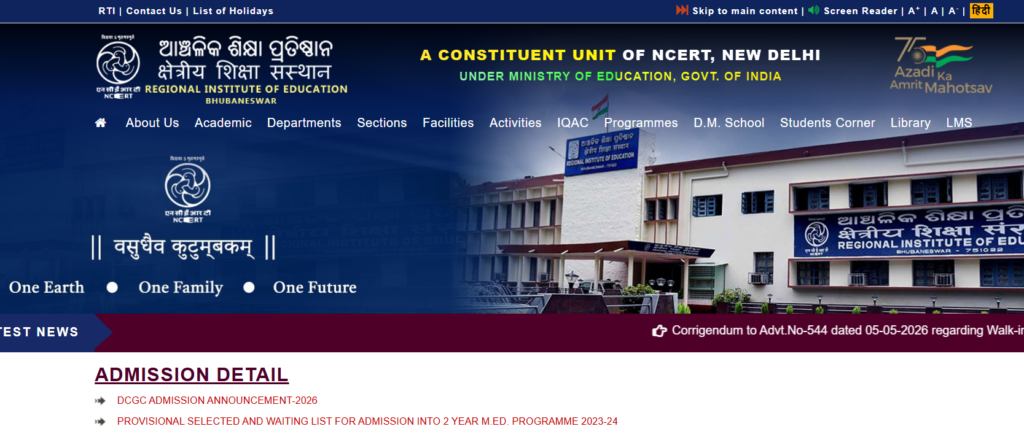
The next step is New Registration. We have to click on “CEE-2026 Registration“. Then “New Registration”. Now we have to enter some details.
These are:
- Full Name as it is on our Class 10 certificate
- Date of Birth
- Mobile Number that is active because we will get an OTP for verification
- Email ID that is active because our login credentials will be sent to this Email ID
- Gender
- Nationality
- Category
We have to complete the OTP verification. We must note our Login ID and Password safely.
Now we have to Login and Fill the Application Form. We will login with our credentials. Then we have to fill the application form.
The NCERT RIE Admission 2026 Online application form will have:
- Personal details like Date of Birth gender, category, PwD status
- Address and domicile state details
- Parent or Guardian details for domicile purpose if applicable
- Academic details like Class 10 Class 12 Graduation, B.Ed. Marks as applicable
- Programme selection: we can choose Group A or B or C and our preferred RIEs. We can select programmes and RIEs for NCERT RIE Admission 2026 Online.
The next step is to Upload Documents. We have to upload scanned copies in format.
We have to upload:
- A recent passport size photograph with a background
- Our signature on a paper with black ink
- Class 10 marksheet for NCERT RIE Admission 2026 Online
- Class 12 marksheet or Graduation or B.Ed. As
- Category certificate if we are SC or ST or OBC-NCL or EWS
- PwD certificate if we have one
- Domicile certificate or Government employee parent posting certificate
All these documents should be in PDF format and not more than 500 KB.
Now we have to Preview and Verify our application form. We have to click “Preview” and check all the details carefully. If we find any errors we can correct them before clicking “Submit”. Once we submit our application form we cannot change the details unless a correction window is opened for NCERT RIE Admission 2026 Online.
The next step is to Pay the Application Fee. After we click “Submit” we will be redirected to the CC Avenue payment gateway. We have to pay the application fee.
The application fee is ₹1,000 for General or OBC or EWS. It is ₹500 for SC or ST or PwD. We must save the payment transaction number for NCERT RIE Admission 2026 Online.
The final step is to Download the Confirmation. After we make the payment the application form with a confirmation number will be displayed. We have to download and print the confirmation slip. We must keep it for use like admit card, counselling and admission, for NCERT RIE Admission 2026 Online.
NCERT RIE CEE 2026 – Courses Fee Structure (Annual Programme Fee)
| Programme | Approx. Total Fee (Full Programme) |
|---|---|
| B.Sc. B.Ed. (4 years) | ₹26,000 – ₹40,000 (total) |
| B.A. B.Ed. (4 years) | ₹26,000 – ₹40,000 (total) |
| B.Ed. (2 years) | ₹12,000 – ₹20,000 (total) |
| B.Ed.–M.Ed. (3 years) | ₹18,000 – ₹30,000 (total) |
| M.Ed. (2 years) | ₹12,000 – ₹20,000 (total) |
| M.A. Education Technology (2 years) | ₹12,000 – ₹20,000 (total) |
Note: The fees mentioned earlier are an estimate from past years. The actual fee for the 2026-27 programme will be shared in the Information Bulletin on the cee.ncert.gov.in website.
RIE education is heavily subsidized by the Government of India. This makes it one of the affordable and good options for teacher education in India. The subsidy from the Government helps keep the costs low. So RIE education is a choice, for those looking for quality teacher education.
NCERT RIE Admission 2026 – Programme-wise Career Path
| Programme | After Completing | Career Options |
|---|---|---|
| B.Sc. B.Ed. / B.A. B.Ed. | Eligible to teach Classes 6–10 | KVS, NVS, Sainik Schools, Army Schools, State Govt Schools, CBSE-affiliated schools |
| B.Ed. (Group B) | Eligible to teach Classes 6–10 | KVS, NVS, Central/State School Teacher, Private schools |
| B.Ed.–M.Ed. (Group B) | Eligible as teacher + teacher educator | School teacher + B.Ed. college lecturer |
| M.A. Education Technology | Specialist in educational technology | E-learning developer, education researcher, educational media |
| M.Ed. (Group C) | Eligible as teacher educator | B.Ed. college faculty, Principal, Education Department, Ph.D. in Education |
| M.Sc. Ed. (6 years, Group A) | Dual expert — Science + Education | Senior subject teacher, Science education researcher |
Join Our Social Media Channels
| Platform | Action |
|---|---|
| Join Our WhatsApp Channel | Follow Now |
| Join Our Telegram Channel | Follow Now |
| IMPORTANT LINKS | |
| NCERT RIE Admission 2026 Apply Online | Click Here |
| NCERT RIE 2026 Notification | Click Here |
| Official Website | NCERT RIE Website |
| Homepage | Click Here |
FAQ – NCERT RIE Admission 2026
When will the NCERT RIE CEE 2026 application form be available?
The NCERT RIE CEE 2026 application form will be available online on 15 May 2026 at the website cee.ncert.gov.in.
What is the last date to apply for NCERT RIE CEE 2026?
You need to apply for the NCERT RIE CEE 2026 before the date which will be in June 2026. You should check the website cee.ncert.gov.in for the date after 15 May 2026. Normally the last date is around June.
When is the NCERT RIE CEE 2026 exam?
The NCERT RIE CEE 2026 exam will be on 28 June 2026 which’s a Sunday. If there are a lot of candidates then they might have the exam on another date well.
What is the application fee for NCERT RIE CEE 2026?
The application fee for the NCERT RIE CEE 2026 is one thousand rupees for General or OBC or EWS candidates and five hundred rupees for SC or ST or PwD candidates. You can pay the fee using a debit card or credit card or net banking or UPI through CC Avenue.
Can I apply for programmes and RIEs with one application?
Yes you can apply for programmes and RIEs with just one application for the NCERT RIE CEE 2026. This is one of the things about the RIE CEE. You can apply for programmes across many RIEs if you are eligible.
What is the difference between RIE CEE 2026 and NCET 2026?
The NCERT RIE CEE 2026 is for programmes like B.Sc. B.Ed.. B.a. B.Ed. Or B.Ed. Or M.Ed. Or M.Sc. Ed. At the RIEs which is conducted by the NCERT. The NCET 2026 is for the four year ITEP programme under the NEP 2020 which is conducted by the NTA. These are two exams with two different websites.
What is the marking scheme for NCERT RIE CEE 2026?
The NCERT RIE CEE 2026 has a total of eighty questions. Each question is for two marks so the total marks are one hundred and sixty. If you answer a question wrongly then you will lose half a mark. The exam has three parts which are Teaching Aptitude and Reasoning Ability and Language Proficiency in English.
How is the final merit list calculated for NCERT RIE Admission 2026?
The final merit list for the NCERT RIE Admission 2026 is calculated by taking sixty percent of the NCERT RIE CEE 2026 score and forty percent of the qualifying examination marks. They make merit lists for each programme and each RIE.
I passed Class 12 this year. Can I apply for Group A?
Yes you can apply for Group A which’s for B.Sc. B.Ed.. B.a. B.Ed. If you passed Class 12 this year.. You need to get the minimum marks required to get the final admission.
Is there a domicile requirement for NCERT RIE Admission 2026?
Yes there is a domicile requirement for the NCERT RIE Admission 2026. You need to show that you are from the state or union territory where the RIE is located. You can show this by giving a domicile certificate or a government posting certificate of your parent or a certificate from a state authority.
What subjects are tested in the RIE CEE 2026 exam?
The RIE CEE 2026 exam tests your Teaching Aptitude and Reasoning Ability and Language Proficiency in English. They do not test any subjects like Physics or History. All the groups appear for the exam.
Where can I contact for RIE CEE 2026 queries?
You can call the number 022-61306271 from Monday to Friday between 10 AM and 5 PM for any queries about the RIE CEE 2026. You can also use the helpdesk, on the website cee.ncert.gov.in.