🔴 Latest Update:
10 May 2026:NEET UG 2026 was conducted on 3 May 2026 by NTA. The Provisional Answer Key has been released. Results are expected by June 2026. This post covers the official NEET 2026 eligibility criteria as per the Information Bulletin released on 8 February 2026 by NTA, based on NMC Graduate Medical Education Regulations 2023 and DCI guidelines.
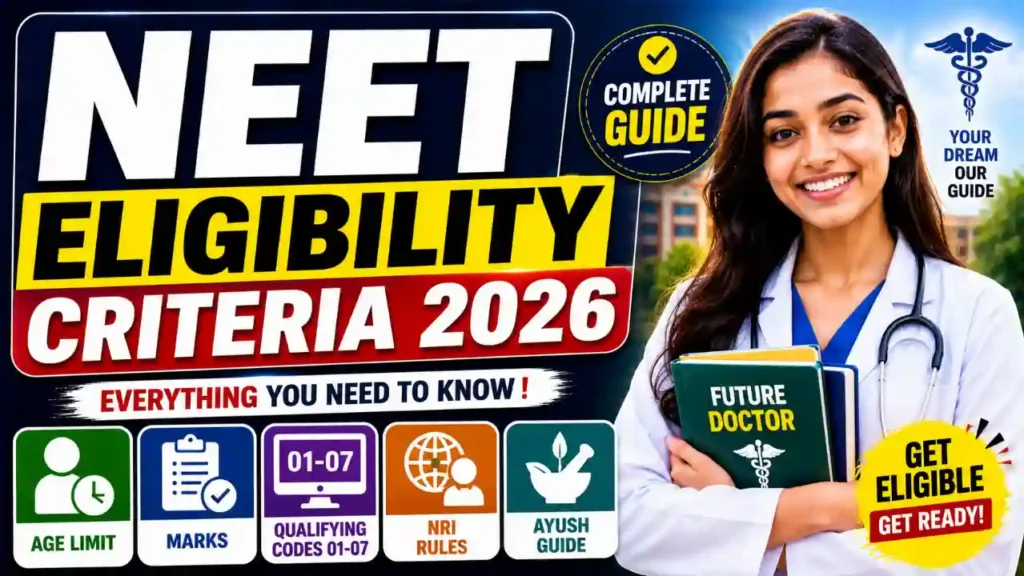
NEET Eligibility Criteria 2026 — the first and most critical step for every medical aspirant in India. The National Testing Agency (NTA) has published the official NEET UG 2026 eligibility rules in the Information Bulletin released on 8 February 2026 as per regulations set by the National Medical Commission (NMC), Dental Council of India (DCI), and the Ministry of Health & Family Welfare, Government of India.
Meeting the NEET eligibility criteria is non-negotiable. A candidate who does not fully satisfy every eligibility condition — even after qualifying NEET with a good rank — can have their admission cancelled during counselling. This guide covers every aspect of NEET 2026 eligibility: age limit, educational qualification, minimum marks, nationality rules, qualifying codes (01 to 07), special cases for droppers, NIOS students, PCM students, NRI/OCI candidates, and AYUSH courses.
NEET Eligibility Criteria 2026 – Overview
| Eligibility Parameter | Details |
|---|---|
| Exam Name | NEET UG 2026 (National Eligibility cum Entrance Test) |
| Conducted By | National Testing Agency (NTA) |
| Exam Date | 3 May 2026 (Sunday) |
| Governing Bodies | NMC, DCI, NCISM, NCH, Ministry of Health & Family Welfare |
| Official Website | neet.nta.nic.in |
| Courses Covered | MBBS, BDS, BAMS, BHMS, BUMS, BSMS, BSc Nursing (AIIMS/JIPMER), BVSc, AH |
| Minimum Age | 17 years by 31 December 2026 (Born on or before 31.12.2009) |
| Upper Age Limit | No Upper Age Limit (removed as per Supreme Court directive) |
| Qualifying Exam | Class 12 or equivalent with PCB + English |
| Minimum Marks – General/EWS | 50% in PCB aggregate |
| Minimum Marks – SC/ST/OBC | 40% in PCB aggregate |
| Minimum Marks – General-PwD | 45% in PCB aggregate |
| Minimum Marks – SC/ST/OBC-PwD | 40% in PCB aggregate |
| Number of Attempts | Unlimited |
| Nationality | Indian, NRI, OCI, PIO, Foreign Nationals |
| NEET Score Validity | Valid for 1 year (2026–27 academic session only) |
| Qualifying Codes | Code 01 to Code 07 |
| Appearing Candidates | Eligible (provisional — subject to passing Class 12) |
2026 Age Limit – Complete Details
Minimum Age Limit
The National Medical Commission made some rules for the Graduate Medical Education Regulations 2023. They changed these rules on 16 June 2023. So for UG 2026 you have to be at least 17 years old.
You must be 17 years old by 31 December 2026.
This means you must be born on or before 31 December 2009.
For example if you were born on 1 January 2010 or after that you cannot take the 2026 exam. You will be able to take the 2027 exam.
Upper Age Limit
There is no maximum age limit for NEET UG 2026.
The Supreme Court of India decided this after many people asked them to. They said that the old rule of a 25 year limit is not valid anymore. The same applies to people who’re from reserved categories and had a 30 year limit.
This means that NEET UG 2026 is open, to everyone no matter how old you are.
You can take the UG 2026 exam if you meet the other requirements it does not matter if you are a dropper or a repeater or how old you are when you take the exam.
2026 Educational Qualification
To be eligible for NEET 2026 you need to have the right educational qualification.
- The qualifying examination is very important.
- Candidates must have. Be currently appearing in the Class 12 examination.
- This Class 12 examination should be a Senior equivalent examination.
- It should be from a recognized Board in India or abroad.
- The Class 12 examination must have the subjects listed below.
- These mandatory subjects are necessary, for NEET 2026.
- So you need to check if your Class 12 examination has these subjects.
Mandatory Subjects for NEET 2026
| Subject | Type | Required |
|---|---|---|
| Physics | Theory + Practical | Compulsory |
| Chemistry | Theory + Practical | Compulsory |
| Biology / Biotechnology | Theory + Practical | Compulsory |
| English | Theory | Compulsory |
| Mathematics | — | NOT required |
Important: To pass the test you have to do in each subject. It is not about getting a good total score. If you fail in one subject, like Chemistry you will not be able to take the 2026 even if you scored really well in Physics, Chemistry and Biology overall. You have to pass each subject like Physics, Chemistry and Biology on its own. The NEET 2026 requires you to pass each subject like Chemistry to be eligible.
Minimum Marks in PCB (Class 12) for NEET 2026
| Category | Minimum PCB Aggregate |
|---|---|
| General / EWS | 50% |
| SC / ST / OBC | 40% |
| General – PwD (Physically Disabled) | 45% |
| SC / ST / OBC – PwD | 40% |
PCB Aggregate means: To calculate the percentage you need to add the marks you got in Physics and Chemistry and Biology or Biotechnology. Then you divide this sum by the marks you could have got in these three subjects. After that you multiply the result by 100. The marks you got in English are not part of this calculation.
NEET 2026 Nationality Eligibility
| Nationality | Eligible for NEET? | Special Requirement |
|---|---|---|
| Indian Nationals | Yes | Standard documents |
| NRI (Non-Resident Indians) | Yes | Certificate from Indian Diplomatic Mission in country of residence |
| OCI (Overseas Citizens of India) | Yes | OCI card; treated as Indian National (Supreme Court order 3 Feb 2023) |
| PIO (Persons of Indian Origin) | Yes | PIO card proof |
| Foreign Nationals | Yes | Valid passport + equivalency certificate from AIU + NMC recognition |
For OCI Candidates:
The Supreme Court made a ruling on February 3 2023. According to this ruling OCI candidates still have the admission benefits they had, before the 2021 MHA notification.
This means they are treated like nationals in most counselling processes. However some institutions may have their rules.
For Foreign-Educated Students:
You must have completed Class 12 or something similar. You need to have studied Physics, Chemistry, Biology and English in your home country.
Your qualification must be recognized by the Association of Indian Universities also known as AIU. The National Medical Commission or NMC must also accept it.
NEET 2026 Qualifying Exam Codes (01 to 07) – Complete Guide
This is the searched part about NEET eligibility. And it can be really confusing.
Every student has to choose the qualifying exam code when they fill out the NEET 2026 application form.
If they pick the wrong code their form might get. They could get disqualified during counselling.
The NEET 2026 application form is a document and selecting the correct qualifying exam code, for NEET eligibility is essential. So candidates must be very careful when selecting the qualifying exam code for NEET.
The qualifying exam code is a part of the NEET eligibility criteria.
| Code | Who Should Select | Details |
|---|---|---|
| Code 01 | Class 12 appearing in 2026 (result awaited) | Currently studying in Class 12, result not yet declared. If candidate fails after declaration — not eligible for admission |
| Code 02 | Passed Class 12 in previous years / Droppers / NIOS / Open School | Completed Class 12 from CBSE / ICSE / State Board / NIOS / Open School in any previous year. Dropper students (NEET repeaters) also use this code |
| Code 03 | Passed Intermediate / Pre-Degree Science exam | Passed Intermediate or Pre-Degree examination in Science stream from any recognized Indian University/Board with PCB and English |
| Code 04 | Passed Pre-professional / Pre-medical examination | Completed a pre-professional or pre-medical examination after Class 12 / Pre-University / equivalent exam, with PCB + English including practicals |
| Code 05 | Passed 1st year of B.Sc. AND Class 12 | Has passed the first year of a Bachelor’s degree AND also passed Class 12 with PCB + English |
| Code 06 | B.Sc. graduate with PCB subjects | Completed B.Sc. with at least two subjects from (Physics / Chemistry / Biology / Biotechnology) AND earlier passed Class 12 with PCB + English |
| Code 07 | NRI / OCI / Foreign Nationals | Passed any examination equivalent to Class 12 Science from outside India, with 2 years of study in Physics, Chemistry, Biology/Biotechnology + English including practicals |
Quick Code Selection Guide
| Your Situation | Use Code |
|---|---|
| Currently in Class 12 (2026) | 01 |
| Passed Class 12 in 2025, 2024, 2023, or earlier | 02 |
| NEET dropper (appeared before, now re-attempting) | 02 |
| Passed from NIOS or Open School | 02 |
| Passed Intermediate/Pre-Degree Science | 03 |
| Completed pre-medical course after Class 12 | 04 |
| Passed 1st year BSc + Class 12 both | 05 |
| BSc graduate with Physics/Chemistry/Biology | 06 |
| NRI / OCI / Foreign student | 07 |
Warning: If you choose the wrong code the National Testing Agency will probably reject your application.. They may ask you questions, about your eligibility when you go for counselling.
If you find out that you have chosen the wrong code you can use the National Testing Agency Correction Window to correct it. The National Testing Agency usually opens this window after they stop taking registrations. You can fix the mistake during this time.
NEET Eligibility 2026 – Special Cases Explained
- NEET 2026 eligibility criteria for dropper students
Students who took NEET in 2025 or before and want to take it in 2026 can do so. Here is what they need to do:
- Choose Code 02 in the application form.
- There is no limit on how times they can take NEET.
- They must be 17 years old by 31 December 2026.
- They must have passed Class 12 with the required marks in Physics, Chemistry and Biology.
The good news is that there is no age limit and no limit on how many times they can take NEET.
- NEET 2026 eligibility for NIOS students
Students who completed Class 12 from NIOS or a State Open School are eligible for 2026. Here are the requirements:
- They must have studied Physics, Chemistry, Biology and English.
- They must have the required marks in Physics, Chemistry and Biology (50% for General and 40% for Reserved).
- They must have taken exams in science subjects.
- They need to choose Code 02 in the application form.
Recently it was clarified that NIOS and private students are eligible for NEET.
- NEET Eligibility for PCM Students (Biology as Additional Subject)
This is a relief for students who studied Physics, Chemistry and Mathematics in Class 12 but took Biology as an additional subject. They are also eligible for 2026:
- They must have passed Biology as a subject from a recognized board.
- The Biology exam must include theory and practical parts.
- They must show the required documents during counselling.
This allows students who studied PCM but want to study medicine to apply.
Note that the Physics, Chemistry and Biology marks will be used to calculate eligibility (50%/40%/45%). Mathematics marks are not counted.
- NEET Eligibility for Gap Year Students
Students who took a gap year after Class 12 can apply for 2026. Here is what they need to do:
- The earlier rule of study for 2 years is no longer required.
- They must be 17 years old have the required marks in Physics, Chemistry and Biology and have studied the required subjects.
- They need to choose Code 02 in the application form.
They can take NEET as times as they want.
- NEET Eligibility for Class 12 Appearing Students (2026)
Students who are in Class 12 in 2026 and have not yet received their results can apply for NEET:
- They need to choose Code 01 in the application form.
- Their admission will be provisional until they pass Class 12 with the required marks in Physics, Chemistry and Biology.
- If they fail Class 12 they will not be eligible for admission that year.
They must submit their Class 12 passing certificate and marksheet before counselling.
- NEET Eligibility for Foreign-Educated Students
Students who completed their schooling outside India must ensure:
- Their Class 12 qualification is recognized by the Association of Indian Universities.
- They studied Physics, Chemistry, Biology and English.
- They cleared both theory and practical exams in science subjects.
- They must get an equivalency certificate from the Association of Indian Universities before counselling.
They need to choose Code 07 in the application form. NRI/OCI applicants must attach a certificate, from the Indian Diplomatic Mission in their country of residence.
NEET 2026 Eligibility for AYUSH Courses (BAMS, BHMS, BUMS, BSMS)
The National Eligibility cum Entrance Test 2026 is also the way to get into AYUSH courses, like Ayurveda and Yoga and Unani and Siddha and Homeopathy.
| AYUSH Course | Full Name | Governing Body | NEET Required |
|---|---|---|---|
| BAMS | Bachelor of Ayurvedic Medicine & Surgery | NCISM | Yes |
| BHMS | Bachelor of Homeopathic Medicine & Surgery | NCH | Yes |
| BUMS | Bachelor of Unani Medicine & Surgery | NCISM | Yes |
| BSMS | Bachelor of Siddha Medicine & Surgery | NCISM | Yes |
Eligibility for AYUSH courses:
To be eligible for AYUSH courses you have to meet a requirements.
You must be least 17 years old by 31 December 2026.
You also need to have studied Physics, Chemistry, Biology or Biotechnology and English in Class 12.
The minimum marks you need to have scored in Physics, Chemistry and Biology are 50 percent if you are a General student and 40 percent if you are from the SC, ST or OBC category.
According to the rules AYUSH courses require students to take the UG exam.
This is because of what’s stated in Section 14 of the NCISM Act 2020 and the NCH Act 2020.
So if you want to study BAMS, BHMS, BUMS or BSMS you have to do in the NEET exam.
After that you have to take part in the AYUSH Counselling, which is organized by the AACCC or the counselling that is done by your state.
This is how you can get into AYUSH courses, like BAMS, BHMS, BUMS or BSMS.
NEET 2026. Number of Attempts
Many students wonder about this. The official word is:
- There is no limit on how times you can take NEET UG.
- You can take NEET as times as you want.
*. Each year you need to meet the age and academic requirements.
You must be least 17 years old.
- Your previous NEET scores don’t add up.
Your current years score matters for counselling.
- Your NEET score is only good for one year.
For example your 2026 NEET score is only valid for admissions, in 2026-27.
NEET 2026 Tie-Breaking Rule
If two or more candidates score the marks in NEET 2026 here is how NTA decides who gets a higher rank:
- They look at the scores of each candidate in Biology then Physics and then Chemistry. The candidate with the score in one subject gets the higher rank.
- If the scores are still the same they look at the scores in each subject one by one. The candidate who got correct answers, in Biology gets the higher rank and so on.
The National Testing Agency uses this method to make sure everyone gets a rank.
| Priority | Tie-Breaking Criterion |
|---|---|
| 1st | Higher marks in Biology (Botany + Zoology) |
| 2nd | Higher marks in Chemistry |
| 3rd | Higher marks in Physics |
| 4th | Lower proportion of incorrect answers to correct answers (across all subjects) |
| 5th | Older candidate (earlier date of birth) gets higher rank |
The tie-breaking rule is really important for students who get scores to the cut-off.
Even a small difference of one mark in Biology can make a change in the rank of the students.
This one mark in Biology can affect the students who score close to the cut-off, in Biology.
NEET 2026 Score Validity
| Parameter | Details |
|---|---|
| Validity Period | 1 year only — valid for 2026–27 admissions |
| Can it be used in 2027? | No — NEET 2026 score cannot be used for 2027 admissions |
| Multiple Attempts in Same Year | Not allowed — only one NEET per year |
| Score Card | Available on neet.nta.nic.in after result declaration |
Getting a score, in the NEET exam does not mean you will definitely get into a college. The NEET is important. The final decision to admit you to a college depends on many things. These things include the rank you get in the NEET if you take part in the counselling process the category you belong to if there are seats and the rules of the college or state you want to study in. The NEET is a part of this process but it is not the only thing that matters.
Tamil Nadu State Board 2021 Special Case (NEET 2026)
Students, from the Tamil Nadu State Board who passed Class 10 in 2021 have a situation when filling out the NEET form.
In 2021 the Tamil Nadu State Board did not hold Class 10 exams because of COVID-19. These students were marked as “Pass” without any marks.
When they fill out the 2026 application form and they choose 2021 as their passing year and Tamil Nadu State Board they will see that the marks field is automatically turned off by the NTA system.
The good news is that these students do not have to enter their Class 10 marks. The system takes care of it.
However they still need to enter their Class 12 marks. This special case only applies to the Class 10 marks field in the application form.
Documents Required for NEET 2026 Eligibility Verification
During counselling after you qualify for NEET you need to show these documents to prove you are eligible:
| Document | Purpose |
|---|---|
| Class 10 Marksheet & Certificate | Date of Birth proof |
| Class 12 Marksheet | PCB marks + subject verification |
| Class 12 Passing Certificate | Board-level pass confirmation |
| NEET 2026 Admit Card | Exam participation proof |
| NEET 2026 Score Card / Result | Rank and score verification |
| Aadhaar Card / Passport / Voter ID | Identity proof |
| Passport Size Photographs | As specified by counselling authority |
| Category Certificate (SC/ST/OBC/EWS/PwD) | Reservation benefit verification |
| NRI / OCI / PIO Certificate | For NRI/OCI/foreign candidates |
| AIU Equivalency Certificate | For foreign-educated students |
| Biology Additional Subject Certificate | For PCM students with Biology as additional subject |
| APAAR ID | Academic Bank of Credits linkage |
NEET 2026 vs NEET 2025 – Eligibility Changes
| Parameter | NEET 2025 | NEET 2026 |
|---|---|---|
| Minimum Age | 17 years by 31 Dec 2025 | 17 years by 31 Dec 2026 |
| Upper Age Limit | No limit | No limit |
| Number of Attempts | Unlimited | Unlimited |
| PCM Students (Biology Additional) | Eligible | Eligible |
| NIOS Students | Eligible | Eligible |
| OCI Students | Indian National status | Indian National status |
| Gap Year Students | Eligible | Eligible |
| Qualifying Codes | 01–07 | 01–07 |
Join Our Social Media Channels
| Platform | Action |
|---|---|
| Join Our WhatsApp Channel | Follow Now |
| Join Our Telegram Channel | Follow Now |
| IMPORTANT LINKS | |
NEET Eligibility Criteria notification | Click Here |
| Official Website | NEET Website |
| Homepage | Click Here |
FAQ: – NEET Eligibility Criteria 2026
What is the minimum age for 2026?
You have to be at 17 years old by 31 December 2026 to appear for NEET 2026. This means you should be born on or before 31 December 2009.
Is there an age limit for NEET 2026?
No there is no age limit for NEET UG 2026. The Supreme Court says that people of any age can take the 2026 exam.
What percentage is required in Class 12 for 2026?
For 2026 you need to have at least 50% marks in Physics, Chemistry and Biology for the General and EWS categories. For the SC, ST and OBC categories you need 40% marks.. For the General-PwD category you need 45% marks. These marks should only be in Physics, Chemistry and Biology. English and other subjects do not count.
How times can I attempt NEET?
You can take the exam as many times as you want. There is no limit to the number of times you can attempt NEET long as you meet the age and academic requirements for that year.
Is Mathematics compulsory for NEET 2026?
No Mathematics is not required for 2026. The main subjects you need to know are Physics, Chemistry, Biology or Biotechnology and English.
Can PCM students apply for 2026?
Yes students who studied Physics, Chemistry and Mathematics can apply for 2026 if they also took Biology or Biotechnology as an extra subject and passed it.
Are NIOS students eligible for 2026?
Yes students who completed Class 12 from NIOS or any recognized State Open School are eligible for 2026 if they studied Physics, Chemistry, Biology or Biotechnology and English including practical exams.
What is Qualifying Code 01 and who should use it?
NEET Qualifying Code 01 is for students who are taking Class 12 in 2026 and are waiting for their results. If you fail Class 12 after the results are out you will not be eligible for admission.
What is NEET Qualifying Code 02?
NEET Qualifying Code 02 is for students who have already passed Class 12 in years. This includes students who took a break NIOS students and students from any recognized board who completed Class 12 before 2026.
Are NRI and OCI students eligible for NEET 2026?
Yes NRI, OCI, PIO and Foreign Nationals can take the 2026 exam. NRI and OCI students need to submit a certificate from the embassy in their country.
can gap year students appear for 2026?
Yes students who took a gap year can appear for 2026. It does not matter if you took one or more years off. You are still eligible.
Is NEET 2026 score valid for 2027 admissions?
No your NEET 2026 score is only valid for the 2026-27 year. You cannot use it to apply for admissions in 2027.
What is the tie-breaking rule in NEET 2026?
If two students have the marks in NEET 2026 the ranking is decided by:
who got more marks in Biology
who got more marks in Chemistry
who got more marks in Physics
who got fewer incorrect answers
who is older
Is NEET required for AYUSH courses like BAMS, BHMS, BUMS, BSMS?
Yes you need to take the UG exam to get into AYUSH undergraduate courses like BAMS, BHMS, BUMS and BSMS.
What happens if I qualify NEET but don’t meet eligibility criteria?
If you qualify for NEET but do not meet the eligibility criteria your admission can be cancelled at any time. Even after you join college. So always check if you are eligible, before applying for 2026.