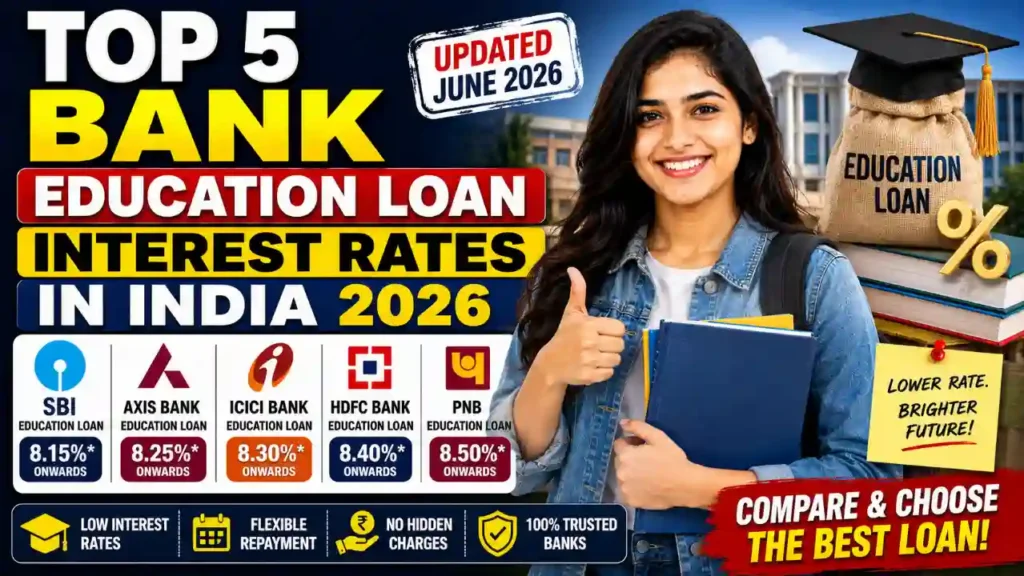
TheTop 5 Bank Education Loan Interest Rates in India as of June 2026 are:
- Punjab National Bank (PNB). It starts at 8.10 percent per year.
- State Bank of India (SBI). It starts at 8.65 percent per year.
- Union Bank of India. It starts at 9.10 percent per year.
- Canara Bank. It starts at 9.25 percent per year.
- Bank of Baroda (BOB). It starts at 9.70 percent per year.
All of these education loan banks are public sector banks. These public sector banks offer the competitive education loan interest rates in India. This is especially true for students who have collateral or a strong academic record or students who get admission to premier institutes like IITs or IIMs or NITs. Girl students get a concession of 0.50 percent at most of these education loan banks.
Keep reading for the comparison of these education loans the eligibility criteria for education loans the documents required for education loans, expert strategies to lower your education loan interest rate further and 12 answered frequently asked questions, about education loans.
Introduction
Every year than 1.3 million Indian students get education loans to pay for their higher studies in India and other countries. But most families do the thing that costs them a lot of money: they go to the nearest bank take the interest rate they are given and sign the papers without looking at other options.
The difference between 8.10 percent and 10.50 percent interest on a loan of twenty lakh rupees for ten years is a deal. You will pay than 2.8 lakh rupees in extra interest. This is money that you could have used to pay rent get certifications or save for emergencies.
This guide will help you understand things better. We looked at the interest rates of the 5 banks in India for education loans in June 2026. We got this information from the banks websites the Reserve Bank of India and the Vidyalakshmi portal. You will also find out what you need to be eligible for a loan what documents you need to submit, how to repay your loan and what subsidy schemes the government offers. We will also tell you which bank is really the best for your situation.
If you want to study at the Indian Institute of Technology the National Institute of Technology or a university, in another country this guide is all you need to compare education loans from banks.
What is an education loan interest rate. Why does it matter so much to people who want to study?
An education loan interest rate is the percentage that the bank charges you every year on the amount of money you borrow for your education. In a country like India most of the banks that are owned by the government decide their education loan interest rates based on the Repo-Linked Lending Rate or the MCLR. These rates go up and down with the Reserve Bank of Indias repo rate. The Reserve Bank of Indias repo rate is currently 6.25 percent as of June 2026. This rate went down because of the cuts that the Reserve Bank of India made in 2025 and 2026. Education loan interest rates are very important because they affect how money you have to pay back, to the bank for your education loan.
Here’s why even a 1% difference matters enormously:
| Loan Amount | Rate | Tenure | Total Interest Paid |
|---|---|---|---|
| ₹20 lakh | 8.10% | 10 years | ~₹10.9 lakh |
| ₹20 lakh | 10.50% | 10 years | ~₹13.7 lakh |
| Difference | ₹2.8 lakh |
That’s 14 percent of the original loan amount lost just because of a difference, in rates. You really need to shop compare. It is not a choice it is a must.
Top 5 Bank Education Loan Interest Rates – (June 2026)
| Bank | Starting Rate | Max Loan Amount | Processing Fee | Collateral (> ₹7.5L) | Girl Student Concession | Repayment Tenure |
|---|---|---|---|---|---|---|
| PNB | 8.10% p.a. | No upper limit | Nil up to ₹7.5L; 1% above | Required | 0.50% off | Up to 15 years |
| SBI | 8.65% p.a. | Up to ₹1.5 crore | Nil up to ₹20L; ₹10,000 above | Required | 0.50% off | Up to 15 years |
| Union Bank | 9.10% p.a. | Up to ₹1.5 crore | Nil up to ₹7.5L; negotiable above | Required | 0.50% off | Up to 15 years |
| Canara Bank | 9.25% p.a. | Up to ₹1.5 crore | Nil up to ₹10L | Required | 0.50% off | Up to 15 years |
| Bank of Baroda | 9.70% p.a. | Up to ₹1.5 crore | Nil up to ₹7.5L | Required | 0.50% off | Up to 15 years |
Note: The interest rates for loans can go up or down because they are connected to the RLLR or MCLR. These rates may change at any time. The rates we have mentioned are for people who want to borrow than ₹7.5 lakh to study abroad and this information is correct as of June 2026. It is an idea to check the latest interest rates with your bank before you apply for a loan, for study abroad.
Detailed Review of the Top 5 Banks Education Loan Interest Rates
1. Punjab National Bank (PNB): Lowest Starting Rate in 2026
- Interest Rate: 8.10% per year (as of June 2026)
- Loan Amount: much as you need no strict upper limit for students from top institutions
- Processing Fee: No fee for loans up to ₹7.5 lakh; 1% of loan amount if its more than that
Punjab National Bank is offering the best deal on education loans in India right now. They have the interest rate among all major banks. PNBs rates are linked to the RBIs repo rate, which means if the repo rate goes down your EMI will also decrease.
Punjab National Bank has education loan options:
- PNB Udaan. For studying abroad; covers tuition fees, living expenses, travel and insurance
- PNB Saraswati. For studying in India at good colleges
- PNB Kaushal. For vocational and skill development courses
- PNB PM-Vidya Lakshmi. For students who qualify for the government subsidy scheme
Punjab National Bank is a good choice for: Students who have grades some property to use as collateral and a co-applicant with a stable income. This is especially true if you’re applying to colleges.
One thing to note: It can take 4–6 weeks to process your loan application at PNB branches. So if you have a deadline, for your visa make sure to apply early.
2. State Bank of India (SBI): Most Widest Coverage
- The interest rate for SBI education loans is from 8.65% to 10.65% per year. It depends on the scheme. How much you borrow.
- You can borrow up to ₹1.5 crore for studies in India;. Up to ₹3 crore under the Global Ed-Vantage scheme for studies abroad.
- There is no processing fee for loans up to ₹20 lakh. For loans above ₹20 lakh the processing fee is ₹10,000.
SBI is Indias bank. Many students and families trust SBI for education loans. SBI has a scheme called Global Ed-Vantage. It is for students going to over 30 countries. The loan covers tuition fees, living expenses, travel and study tour costs.
SBI has education loan schemes. Here are a few:
- SBI Student Loan Scheme. You can borrow up to ₹20 lakh for studies in India and ₹30 lakh for studies
- SBI Scholar Loan Scheme. This is for students going to top institutions like IITs, IIMs and NITs. The interest rate is lower. You can borrow more.
- SBI Global Ed-Vantage. This is for full-time programs. You can borrow up to ₹1.5 crore.
- SBI Skill Loan Scheme. This is for courses. You can borrow up to ₹1.5 lakh.
One big advantage of SBI education loans is that girl students can get a 0.50% discount on the interest rate. Students going to top institutions like IITs, IIMs and NITs can also get a 0.50% discount. This means the effective interest rate can be as low as 7.65%.
SBI education loans are best for: students going to colleges in India or abroad families who have property to use as collateral and borrowers who want to borrow a large amount with the backing of a trusted government bank, like SBI.
3. Union Bank of India: Fast Processing, Competitive Rates
The interest rate of Union Bank of India is 9.10% to 11.50% per year.
You can get a loan of up to ₹1.5 crore from Union Bank of India.
The processing fee is zero for loans up to ₹7.5 lakh. You can negotiate for higher amounts.
Union Bank of India is very good at processing loans compared to other public sector banks. It processes applications faster than State Bank of India. The interest rates of Union Bank of India are linked to RLLR. They become more favorable when the Reserve Bank of India reduces rates.
Here are the key schemes of Union Bank of India:
- Union Education Loan. This is for students who want to study in India and abroad
- Union Special Education Loan. This is for students from institutions
The unique advantage of Union Bank of India is that it offers education loans under the Central Sector Interest Subsidy scheme.
Under this scheme the government pays the interest during the period when you do not have to pay the loan back for students from poor families that is families with income below ₹4.5 lakh per year.
This means Union Bank of India can effectively make your interest cost zero during your study period. Union Bank of India is best for students who need loans quickly or those who are eligible, for the government interest subsidy.
4. Canara Bank: A Good Choice for Education in India
- Interest Rate: 9.25% to 12.50% per year
- Loan Amount: Up to ₹1.5 crore for colleges no limit in some plans
- Processing Fee: No fee for loans up to ₹10 lakh
Canara Bank is a popular choice for education loans for students in India especially those in state government colleges and central universities. Its interest rates are a bit higher than PNB and SBI. Still good compared to other public sector banks.
Canara Bank offers education loan plans:
- Vidya Turant. For students in IITs, NITs and government colleges
- IBA Model Scheme. A plan for studying in India
- Canara Bank Abroad Loan. For full-time courses at universities
One good thing about Canara Bank is that it allows you to change your loan repayment plan after you graduate if you are having trouble finding a job. This is an option that many private lenders do not offer.
Best for: Students in government colleges or central universities, in India and those who want the option to change their loan repayment plan.
5. Bank of Baroda (BOB): for NRI Families and Defence Personnel
- Interest Rate: 9.70% to 12.25% per year
- Loan Amount: Up to 1.5 crore rupees
- Processing Fee: No fee for loans up to 7.5 lakh rupees; 1 percent above that
Bank of Baroda is a good option for two types of people. One NRI families with kids studying in India or abroad. Two, kids of defence personnel. The Baroda Yodha Education Loan gives a rate for army, navy and air force families.
BOB has key schemes:
- Baroda Scholar. For studying abroad at top foreign universities like MBA and MS; interest rates start at 9.70 percent per year
- Baroda Education Loan for Premier Institutions. For studying at IITs and IIMs
- Baroda Gyan. For studying in India
- Baroda Yodha Education Loan. A special rate for kids of defence personnel
One advantage of BOB is that it offers both floating and fixed interest rates. This is rare among public sector banks. If you think interest rates will go up in a years you can lock in a fixed rate to avoid higher EMIs.
Best for: Students going abroad for programs like MBA and MS NRI families and kids of defence personnel. Bank of Baroda is good, for them.
Eligibility Criteria – All 5 Banks at a Glance
Most public sector banks have rules for who can get an education loan, based on the Indian Banks Association Model Education Loan Scheme. Here are the main things you need to know:
Student Eligibility:
- You must be a citizen of India
- You are usually between 16 and 35 years old
- You must have gotten into a school through a merit or entrance exam
- You need to have grades. Usually 50 to 60 percent in your last exam
Eligible Courses:
- You can get a loan for college like a bachelors or masters degree or a PhD from a good university
- You can also get a loan for courses like being a doctor, engineer or lawyer
- Some diploma and certificate courses are okay too long as they are at least six months long
- If you get into a good school in India like an IIT or IIM you can get a loan for that
- You can even get a loan for a full-time course at an university in another country
Co-applicant Requirement:
- You need someone to sign the loan with you like a parent, spouse, brother or sister or guardian
- The person who signs with you needs to have an income so the bank knows you can pay back the loan
- If the person who signs with you has a credit score, like 700 or higher you are more likely to get the loan and might even get a better interest rate
Collateral Requirement:
- If you borrow an amount of money like up to ₹7.5 lakh you usually do not need to put up anything as security
- If you borrow than ₹7.5 lakh you need to put up something valuable like a house or some land or a special kind of investment
- Some banks, like the State Bank of India might not require security if you get into a good school.
Documents Required for Education Loan (Complete Checklist)
To get your education loan quickly you need to have all your documents in order. This is the important thing you can do to speed up the process. Here is a list of documents you will need for all 5 banks:
Identity and Address Proof for the Student and Co-applicant:
- Aadhaar Card
- PAN Card
- Passport. You must have this if you are studying abroad
- Voter ID or Driving License. This is proof of identity
- Recent passport-size photographs of the student and co-
Academic Documents:
- Mark sheets for Class 10 Class 12 and graduation. If you have graduated
- Entrance exam scorecard. This could be JEE, NEET, GMAT, GRE, IELTS, TOEFL and so on
- Admission offer letter from the institution where you will be studying
- structure or fee receipt from the college
- Bonafide certificate
- Scholarship documents. If you have any
Income Documents for the Co-applicant:
- Income Tax Returns for the 2-3 years with all the calculations
- Salary slips for the 3-6 months. Or proof of income from your business or profession
- Bank statements for the last 6-12 months
- Form 16. This is for people who are employed and get a salary
Collateral Documents. If you need them:
- Property ownership papers or title deed
- Latest property tax receipt
- Valuation report from a valuer who is approved by the bank
- Encumbrance certificate
- If you are using a Fixed Deposit as collateral: the Fixed Deposit receipt
For Studying Abroad. You will need these extra documents:
- Visa approval letter. Or a copy of your visa application
- I-20 for the USA, CAS for the UK or another admission document
- Cost of study or fee structure in the currency of the country
- Proof of health insurance. Some banks require this for education loans, for studying
Processing Fees Compared – Don’t Overlook This Cost
Processing fees are often ignored, but on a ₹30 lakh loan, a 1% fee means ₹30,000 gone upfront – before you’ve even drawn the loan.
| Bank | Processing Fee |
|---|---|
| PNB | Nil up to ₹7.5L; 1% above |
| SBI | Zero up to ₹20L; ₹10,000 above ₹20L (flat) |
| Union Bank | Nil up to ₹7.5L; bank discretion above |
| Canara Bank | Nil up to ₹10L; varies above |
| Bank of Baroda | Nil up to ₹7.5L; 1% above (max ₹10,000 for some schemes) |
Verdict on fees: SBI wins for large loans (above ₹20 lakh) because its flat ₹10,000 fee is significantly cheaper than 1% of a ₹50 lakh loan, which would be ₹50,000 at other banks.
Repayment. The Moratorium Period Explained
Understanding your repayment timeline is crucial. It’s just as important as the interest rate.
The Moratorium Period
All education loans have a moratorium period. This is a repayment holiday that lasts for the course duration. It also includes 6 to 12 months after you complete your course.. It lasts 6 months after you get a job. Whichever comes first. During this time you don’t have to repay the loan amount.
However interest still builds up during the moratorium period. Many students make a mistake. If you don’t pay the interest during this period it gets added to your loan amount. This process is called capitalization. As a result you end up paying interest on the interest.
Expert tip: If your family can afford it pay the interest during your studies. For example on a ₹20 lakh loan at 9% that’s ₹1,800 per month. This is much better, than having ₹3–4 lakh added to your loan amount.
Repayment Tenure Options
All five banks offer a repayment tenure of up to 15 years after the moratorium period ends. Here’s a quick EMI illustration for a ₹20 lakh loan:
| Tenure | Rate | Monthly EMI |
|---|---|---|
| 5 years | 8.65% | ~₹41,200 |
| 10 years | 8.65% | ~₹24,900 |
| 15 years | 8.65% | ~₹19,900 |
The longer the tenure, the lower the EMI – but the total interest paid increases significantly. The 10-year tenure is generally the sweet spot for most borrowers: affordable monthly payments without excessive total interest outgo.
Prepayment
All five public sector banks allow partial or full prepayment of education loans without any penalty charges. If you land a well-paying job, prepaying aggressively in the first 3–4 years can cut your total interest burden dramatically.
How to Get a Lower Interest Rate – 7 Expert Strategies
The interest rate you see is not always the rate you get. Your actual interest rate depends on who you’re. So how do you get a deal?
- First go to a school: If you get into a top school like IITs, IIMs, NITs, AIIMS or a university that is well known around the world you can get a lower interest rate. For example SBIs Scholar Loan gives interest rates to students who go to these schools.
- Next put up something as security: If you get a loan with security like a house your interest rate can be lower. This can make a difference. About 1% to 2%. If your family owns a house use it to get a deal. You will save a lot of money on interest over ten years.
- Then make sure the person who is applying with you has a credit score: If the person who is applying with you has a good credit score, like 750 or more you have a better chance of getting a lower interest rate. Tell your parent to pay off their credit card bills and loans six months before you apply.
- If you are a girl ask for a discount: If you are a girl you can get an interest rate. Just ask for it when you apply. You have to ask for the 0.50% discount in writing.
- Apply for a loan on the Vidyalakshmi Portal: You can apply to banks at the same time on this website. This can help you get a deal. Sometimes banks give interest rates to people who apply through this portal.
- Ask the bank to change your interest rate often: Instead of changing your interest rate every year ask the bank to do it every quarter. This can help you save money on interest when interest rates are going down.
- Finally pay the interest on your loan while you are still in school: If you pay the interest on your loan while you are, in school you will not owe much money in the end. This is because the interest is not added to the loan so you do not have to pay interest on the interest.
Section 80E Tax Benefit. Every Borrower Must Claim This
When you take an education loan you can get a tax benefit under Section 80E of the Income Tax Act. This means you do not have to pay tax on the interest you pay for your education loan. You can deduct the interest amount from the income that is taxable. There is no limit to how much you can deduct which’s really good. For example Section 80C has a limit. Section 80E does not.
Here are the main things to keep in mind:
- The education loan must be from a bank or a financial institution that the government recognizes or from an organization.
- You can claim this tax benefit for a maximum of 8 years starting from the year you start repaying the loan.
- Only the person who is repaying the loan can get this tax benefit.
Let us look at an example. If you pay ₹1.8 lakh as interest, in one year and you pay 30 percent tax you can save ₹54,000 in tax. If you do this for 8 years you can save ₹4 lakh or more in tax. This makes education loans a good option if you want to save tax. Education loans are one of the ways to borrow money without paying a lot of tax.
Government Subsidy Schemes You Cannot Afford to Ignore
- PM Vidya Lakshmi Education Loan Scheme
The government has a good education loan scheme called PM Vidya Lakshmi Education Loan Scheme. You can find it on the website vidyalakshmi.co.in. This scheme helps students get loans from public sector banks with just one application. The good things about this scheme are that you do not have to pay any processing fees you can get a loan of up to ₹1 crore. You get priority processing at some big banks like SBI, Bank of Baroda and Canara Bank.
- Central Sector Interest Subsidy Scheme
If your parents do not earn a lot of money than ₹4.5 lakh per year then you can get a special benefit. The government will pay the interest on your loan while you are studying. This means you do not have to pay any interest on your loan until you finish your studies.
- Dr. Ambedkar Central Sector Scheme
There is a scheme for students from the SC/ST community who want to study abroad at a good university. The Dr. Ambedkar Central Sector Scheme helps these students by paying part of the interest on their loans up to ₹20 lakh.
- Padho Pardesh Scheme
The Padho Pardesh Scheme is for students from minority communities who want to study. If these students are from a family the government will pay the interest on their loans while they are studying. This helps them a lot because they do not have to pay any interest, on their loan until they finish their studies.
Choosing The Right Bank For You – Expert Recommendation
There is no one bank that’s best for everyone. The best bank for you depends on what you need. Here is how you can decide:
You should choose Punjab National Bank if you have grades something to use as collateral and do not mind waiting a bit longer. Punjab National Bank gives you the interest rate.
You should choose State Bank of India if you need a loan of more than twenty lakh rupees you are going to study abroad you need the maximum amount of loan or you are going to a big institute like IIT or IIM or NIT. State Bank of India does not charge you any processing fees for loans so it is very cost effective.
You should choose Union Bank of India if your family does not earn a lot of money than four and a half lakh rupees and you can get help from the government to pay the interest or if you want your loan to be processed faster than State Bank of India.
You should choose Canara Bank if you are studying in a university in India or if you want to be safe in case you do not get a job after you finish your studies and need to change your loan plan.
You should choose Bank of Baroda if you are from a family of defence personnel or you are a student from another country or you want to pay a fixed interest rate that will not change even if the Reserve Bank of India changes its policies.
If you need a loan quickly and you do not have anything to use as collateral: You can consider companies like HDFC Credila or Avanse. They give you loans without collateral but you will have to pay a bit more interest, around one to two percent more.
Join Our Social Media Channels
| Platform | Action |
|---|---|
| Join Our WhatsApp Channel | Follow Now |
| Join Our Telegram Channel | Follow Now |
Table scroll karne ke liye swipe karein
| IMPORTANT LINKS | |
| PM Vidya Lakshmi Portal | PM Vidya Lakshmi Website |
| Homepage | Click Here |
FAQ – Top 5 Bank Education Loan Interest Rates
Which bank has the education loan interest rate in India in 2026?
As of June 2026 Punjab National Bank offers the starting education loan interest rate at 8.10% per annum. State Bank of India follows at 8.65% making both Punjab National Bank and State Bank of India the affordable options for students with collateral and a strong co-applicant profile.
Can I get an education loan without collateral?
Yes you can get an education loan without collateral. All five public sector banks offer education loans up to ₹7.5 lakh without any collateral. For amounts above ₹7.5 lakh you need collateral like property, FD or LIC policy at these banks. Private NBFCs like HDFC Credila and Avanse offer collateral- loans up to ₹80 lakh but the interest rates are higher, around 11% to 13%.
What happens to my education loan interest during the moratorium period?
The moratorium period is the time you are studying plus 6 to 12 months. During this time interest keeps adding up. If you do not pay this interest it gets added to your loan amount, which means you have to pay money back. It is an idea to pay the simple interest during the study period if you can because it will reduce your total repayment burden.
What is the education loan amount I can get from a public bank?
State Bank of India offers the highest loan amounts. Up to ₹1.5 crore under the Global Ed-Vantage scheme for studies and up to ₹3 crore for select programs. Punjab National Bank and other public banks generally lend up to ₹1.5 crore for education if you have adequate collateral.
Does taking an education loan affect my credit score?
Taking an education loan does not hurt your credit score.. If you miss payments after you start repaying the loan it will hurt your credit score. If you pay your loan on time it helps you build a credit history, which is useful when you want to take a home loan or car loan later.
Can I get an education loan before receiving a college admission letter?
Most banks need an admission offer letter before they give you the loan. However some lenders, like HDFC Credila offer in-principle approval before you get admission, which helps you plan ahead and respond to university decisions quickly.
Are there concessions for girl students?
Yes there are concessions for girl students. All five banks, including Punjab National Bank, State Bank of India Union Bank, Canara Bank and Bank of Baroda offer a 0.50% interest rate concession for girl students. You should ask for this concession when you apply for the loan because it does not always get applied automatically
Can I prepay my education loan without any penalty?
Yes you can prepay your education loan without any penalty. All public sector banks allow prepayment of education loans without any penalty. If you make prepayments in the early years of repayment you can reduce your total interest outgo significantly.
What is the Vidyalakshmi portal. How does it help?
The Vidyalakshmi portal is a website that allows you to apply to banks for education loans at the same time. It lists all the participating banks, their schemes and interest rates. You can apply directly online. This makes the process of comparing and applying for loans simpler.
- RBI official repo rate data: https://www.rbi.org.in
- PM Vidya Lakshmi Portal: https://vidyalakshmi.co.in
- SBI Education Loan Schemes: https://sbi.co.in
- PNB Student Loan page: https://www.pnbindia.in
- BankBazaar Education Loan Rates (June 2026): https://www.bankbazaar.com/education-loan-interest-rate.html
- Income Tax India – Section 80E: https://www.incometaxindia.gov.in