Quick Answer: All 12 Months in German at a Glance
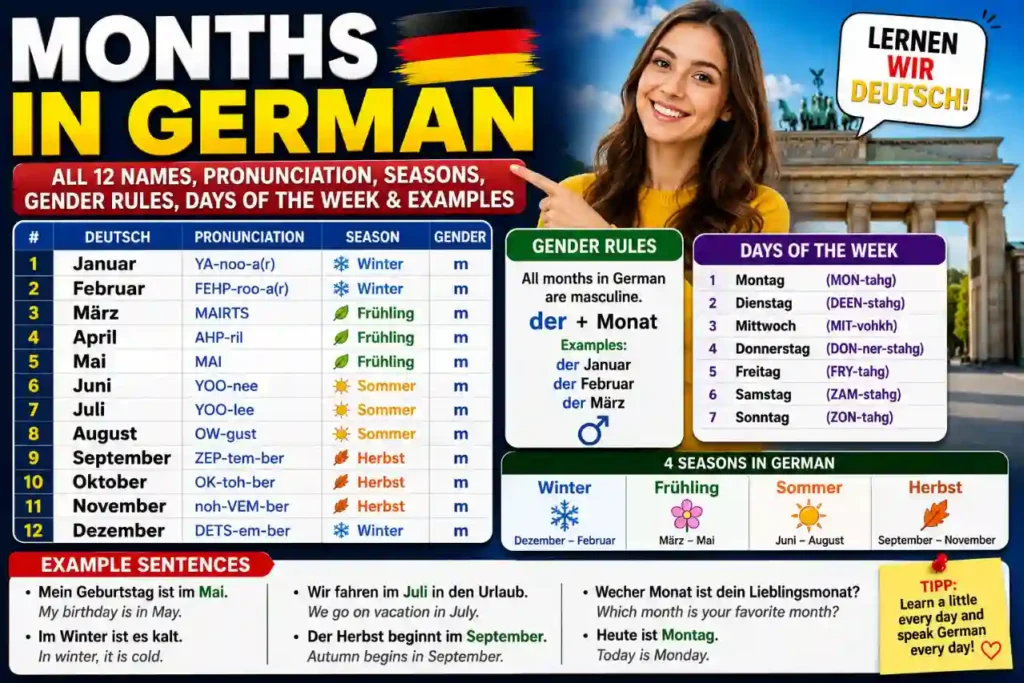
| # | English | German | Pronunciation Guide |
|---|---|---|---|
| 1 | January | Januar | YAH-noo-ar |
| 2 | February | Februar | FAY-broo-ar |
| 3 | March | März | Mertz |
| 4 | April | April | Ah-PRIL |
| 5 | May | Mai | My |
| 6 | June | Juni | YOO-nee |
| 7 | July | Juli | YOO-lee |
| 8 | August | August | OW-goost |
| 9 | September | September | Zep-TEM-ber |
| 10 | October | Oktober | Ok-TOH-ber |
| 11 | November | November | No-VEM-ber |
| 12 | December | Dezember | Day-TSEM-ber |
One important thing to know about grammar is that all twelve months are masculine nouns. The months in German use the article “der“. Like all nouns in German the names of the months are always capitalized. This is true no matter where the months appear in a sentence. German months are always written with a capital letter. The months, in German are masculine so they use “der”.
The 12 months in German are: Januar (January), Februar (February), März (March), April (April), Mai (May), Juni (June), Juli (July), August (August), September (September), Oktober (October), November (November), and Dezember (December). All German months are masculine nouns and use the article “der”. To say “in a month,” use “im” — for example, im Januar means “in January.”
Why Learning Months in German Is Your First Step
If you have just started learning German the months are one of the most useful things to learn first. You will use the months in German every day. When you talk about dates make appointments, book travel discuss birthdays talk about the weather and attend events like Oktoberfest or Weihnachten.
The good thing is that the months in German are really easy to learn. Most of the months in German have the roots as the English months so if you know the English months you already know a lot of the months in German. For example Januar, Februar, September and Oktober are very similar to the months.
There are a few things you need to know about how to say the months in German and some grammar rules like the “im” rule. You should also know some things about the culture. This guide will teach you everything you need to know about the months in German. The 12 months, how to say them correctly which words to use with them the seasons the days of the week and some helpful tips to remember them. The months, in German are a place to start when you are learning German.
Also Read: Top 5 Bank Education Loan Interest Rates in India 2026 (Updated June)
The 12 Months in German. Complete Breakdown with Pronunciation
Let us go through each month in detail. Alongside the pronunciation we will note what makes each German month slightly different from English so you do not develop habits early on.
January. Januar (YAH-noo-ar)
The first thing to notice is that the letter “J” in German is always pronounced like the English “Y”. So Januar sounds like “YAH-noo-ar” not “JAN-yoo-ary”. This is one of the common mistakes beginners make when they say German months. Practice it with: “Im Januar ist es kalt.” (In January it is cold.) This way you will get used to the month January.
February. Februar (FAY-broo-ar)
The German month Februar drops the r” that English “February” has making it shorter and easier to say. You should pronounce it as “FAY-broo-ar”. Note the ending. “-Ar” than “-ary”. A common exam mistake is spelling German month Februar with a r” as “Februarr”.
March. März (Mertz)
The month März is one of the few months that looks quite different from its English counterpart. The ä (a-umlaut) gives it a sound between “e” and “a”. Like the “e” in “bed”. The z at the end is pronounced like “ts” giving us “Mertz”. The month März marks the beginning of spring in Germany celebrated with Easter preparations. For example Osterbrunnen. Easter fountains. Are set up across villages in März and April.
April. April (Ah-PRIL)
This German month is nearly identical to English. The main difference is the emphasis: in German it falls on the syllable. “Ah-PRIL”. Also the “A” at the beginning is pronounced openly like the “a” in “father”. So the German month April sounds like “Ah-PRIL”.
May. Mai (My)
The German month Mai is the month name in German. Just three letters. It rhymes with “my” in English. You can memorize it instantly: Mai = My. The German month Mai is also special because the first of Mai is a holiday in Germany. Tag der Arbeit (Labour Day). With marches, festivals and outdoor celebrations.
June. Juni (YOO-nee)
Again the “J” is a “Y” sound. The month Juni is pronounced “YOO-nee”. It is short, clean and easy. Remember: the German month Juni and the German month Juli sound deceptively similar so focus on the ending. The month Juni ends in “nee” the German month Juli ends in “lee”.
July. Juli (YOO-lee)
The German month Juli is pronounced “YOO-lee”. This is the German month with average temperatures reaching 23–25°C. The German month Juli is tourist season so if you’re planning a trip to Germany you’ll use this word a lot. Practice distinguishing it from the month Juni: the German month Juni = YOO-nee / the German month Juli = YOO-lee.
August. August (OW-goost)
The month August is very close to English but with a German twist. The “Au” is pronounced like the “ow” in “cow” giving you “OW-goost”. The second syllable uses a more rounded “oo” than English. So the German month August sounds like “OW-goost”.
September. September (Zep-TEM-ber)
Here the “S” before a consonant in sounds like “Sh” or “Z”. So the German month September sounds closer to “Zep-TEM-ber”. This is one of the recognizable German months worldwide thanks to Oktoberfest, which actually begins in late September.
October. Oktober (Ok-TOH-ber)
The German month Oktober trades the English “c” for a “k”. A common pattern in German spelling. It is pronounced “TOH-ber” with emphasis on the second syllable. Despite its name the famous Oktoberfest begins in September and runs into early German month Oktober.
November. November (No-VEM-ber)
The month November sounds very similar to English but slightly more clipped at the end. In Germany November 1st (Allerheiligen. All Saints Day) is a holiday in several German states and November 11th begins the Karneval season in cities like Cologne and Düsseldorf.
December. Dezember (Day-TSEM-ber)
The German month Dezember swaps the English “c” for a “z” which in German is always pronounced “ts”. So the German month Dezember sounds like “Day-TSEM-ber”. This is the month of Weihnachten (Christmas) Heiligabend (Christmas Eve on the 24th) and Silvester (New Years Eve on the 31st). The richest German month, in the German calendar.
German Month. Article: The One Rule That Never Changes
In German every noun has a gender. This gender can be masculine, feminine or neuter. Normally you have to remember the gender of each noun. This is one of the things about German.
Months are different. Every month in German is masculine. This means every month uses the article der. There are no exceptions.
For example:
- der Januar, Februar der März, der April der Mai der Juni
- der Juli, der August der September der Oktober, der November, der Dezember
So when you talk about months, in German you do not have to think about the article. You always use der with months. German months always use the masculine article der.
Why does gender matter in this case?
It matters because when you talk about a month with a word the gender changes how you say it. For example when you use the word “in” with a month the article changes. In German “the” is “der” for nouns but when you use “in” with it it becomes “dem”.. Then “in dem” becomes “im”.
So here’s a simple rule:
To talk about being in a month always say “im” before the month.
Here are some examples:
- im Januar = in January
- im März = in March
- im Juli = in July
- im Dezember =, in December
This rule works for every month every season and every year. You only need to learn it.
German Month Abbreviations (For Calendars, Forms & Official Documents)
German officially abbreviates months using the first three letters of the full name, followed by a period:
| Month | Abbreviation |
|---|---|
| Januar | Jan. |
| Februar | Feb. |
| März | Mrz. or Mär. |
| April | Apr. |
| Mai | Mai (no abbreviation needed) |
| Juni | Jun. |
| Juli | Jul. |
| August | Aug. |
| September | Sep. or Sept. |
| Oktober | Okt. |
| November | Nov. |
| Dezember | Dez. |
You’ll see these abbreviations on German calendars, train schedules, bank statements, and official forms. Knowing them helps you navigate real-life German documents with confidence.
Seasons in German: Connecting Months to the Four Jahreszeiten
The German word for “seasons” is die Jahreszeiten (literally: “the times of the year”). There are four seasons, and – just like months – they are all masculine nouns using “der”:
| English | German | Months Covered | Pronunciation |
|---|---|---|---|
| Spring | der Frühling | März, April, Mai | FREW-ling |
| Summer | der Sommer | Juni, Juli, August | ZOM-mer |
| Autumn/Fall | der Herbst | September, Oktober, November | Hairpst |
| Winter | der Winter | Dezember, Januar, Februar | VIN-ter |
Just like months, you use “im” before seasons:
- im Frühling = in spring
- im Sommer = in summer
- im Herbst = in autumn
- im Winter = in winter
Cultural connection with seasons:
- When it comes to Frühling, which’s Spring, people in Germany really like to celebrate Ostern, which is Easter and they have these really nice flower festivals all over Bavaria.
- In Sommer, which’s Summer a lot of people go to the beach at the Baltic Sea and you can find outdoor beer gardens or Biergärten almost everywhere.
- Then there is Herbst, which’s Autumn and this is when Oktoberfest happens, usually from late September, to early Oktober. They also have harvest festivals.
- In Winter Germany has these Christmas markets, called Weihnachtsmärkte in every single German city and this is really one of the most beautiful things you can experience in all of Europe and people really love going to the Christmas markets in Winter.
Days of the Week in German: Learn Them Alongside Months
When you are learning German it is an idea to learn the days of the week and the months at the same time. The days of the week in German are like the months. They are all masculine which means you use the word der to describe them. Also you always write the days of the week with a capital letter just like you do with the months. Learning the days of the week in German and the months, in German will really help you build your vocabulary of time in German.
| English | German | Pronunciation |
|---|---|---|
| Monday | der Montag | MON-tahg |
| Tuesday | der Dienstag | DEENS-tahg |
| Wednesday | der Mittwoch | MIT-vokh |
| Thursday | der Donnerstag | DON-ners-tahg |
| Friday | der Freitag | FRY-tahg |
| Saturday | der Samstag | ZAMS-tahg |
| Sunday | der Sonntag | ZON-tahg |
Key usage rule for days: Just like months use “im,” days of the week use “am” (a contraction of “an dem”):
- am Montag = on Monday
- am Freitag = on Friday
- am Sonntag = on Sunday
So you now have two essential preposition patterns:
- im + month/season (im Januar, im Sommer)
- am + day of the week (am Dienstag, am Samstag)
Practice sentence combining both: “Am Freitag im Juli fahre ich nach Berlin.” (On a Friday in July, I am going to Berlin.)
How to Write Dates in German: The Complete Format
Now that you know months and days, let’s look at how Germans actually write and say full dates – because it’s different from English in some important ways.
Written Date Format in German
German dates follow the order: Day.Month.Year
- 15.08.2026 = 15th August 2026
- 01.01.2026 = 1st January 2026
- 25.12.2026 = 25th December 2026
Note: Germans use dots as separators, not slashes (/) like Americans or dashes (-) like the British.
Spoken/Written Date with Month Names
When you write a date in a letter or document:
Berlin, den 19. Juni 2026 (Berlin, 19 June 2026)
When you say a date loud Germans use ordinal numbers like this:
- Today is the nineteenth of June.
They say it like this: “Heute ist der neunzehnte Juni.”
- My birthday is on the fifth of March.
They say it like this: “Mein Geburtstag ist am fünften März.”
The ordinal number takes a suffix.
For numbers, between 2 and 19 it takes the “suffix.
- 1. → Ersten
- 2. → Zweiten
- 3. → Dritten
For 20 and above it takes the “-ste” suffix.
- 5. → Fünften
- → Neunzehnten
Using Months in Sentences: 20 Practical Examples
Reading about months is useful but using them in real sentences is what actually builds fluency. Here are 20 practical example sentences covering situations like talking about birthdays and months in German sentences.
Talking about birthdays in sentences is really helpful.
Mein Geburtstag ist im März.. My birthday is in March.
Sie wurde im Oktober geboren.. She was born in October.
Talking about the weather in months in sentences is also useful.
- Im Januar schneit es oft in Deutschland.. In January it often snows in Germany.
- Der August ist der heißeste Monat in Berlin.. August is the month in Berlin.
- Im Dezember wird es dunkel.. In December it gets dark early.
Planning and appointments in months in sentences are very important.
- Das Meeting ist am Montag im September.. The meeting is on Monday in September.
- Wir fahren im Juli in den Urlaub.. We are going on vacation in July.
- Der Kurs beginnt im Februar und endet im Mai.. The course starts in February. Ends in May.
Asking about time in months in sentences can be tricky.
- In welchem Monat hast du Geburtstag?. Which month is your birthday in?
- Wann kommst du zurück?. Im April.. When are you coming back?. In April.
Cultural and seasonal months in sentences are really interesting.
- Das Oktoberfest begins in September.. Oktoberfest begins in September.
- Im Dezember gibt es überall Weihnachtsmärkte.. In December there are Christmas markets everywhere.
- Im Frühling blühen die Kirschbäume.. In spring the cherry trees blossom.
- Karneval findet im Februar statt.. Karneval takes place in February.
Formal or professional use of months in sentences is necessary.
- Der Vertrag läuft bis Ende März.. The contract runs until the end of March.
- Die Rechnung ist fällig am 15. November.. The invoice is due on 15 November.
- Das Geschäftsjahr begins in January.. The financial year starts in January.
Travel and everyday life in months, in sentences are very common.
- Im Sommer sind die Züge sehr voll.. In summer the trains are very full.
- Im Oktober sind die Wälder wunderschön.. In October the forests are beautiful.
- Wir treffen uns am Samstag im August.. We are meeting on a Saturday in August.
Memory Tricks to Learn German Months Faster
Here are some techniques that really work to help you remember the months:
- The “Look-shortcut
Let us group the months that are almost the same as the English ones and learn them together:
- April, September, November. These are barely changed
- Januar, Februar, Oktober, Dezember. These have just slight spelling changes
This means we only have to pay attention to a few months: März, Mai, Juni, Juli. And the good thing is that these months even rhyme with each other.
- The “J = Y” rule for all J words
In German the letter “J” sounds like “Y”. So when you remember this Januar becomes YAH-noo-ar Juni becomes YOO-nee and Juli becomes YOO-lee. Try saying “January with a Y” until it feels natural.
- Link months to things you know
For example:
- Juli is the month when people prepare for Oktoberfest
- Dezember is the month when we have Weihnachten or Christmas
- Februar is the month when we have Karneval, which’s like the German Mardi Gras
- Oktober is the month when we have Unity Day and Oktoberfest
- The “der” rule
Just remember that all German months are “der”. Never say “die März” or “das November”. Always say “der”. This is the same for the seasons and the days of the week. Repeat this to yourself until it becomes automatic.
- The “im” rule
Write “im”. The name of the month on sticky notes and put them on your calendar at home. Every time you see a date say it loud in German. For example “Im Juni fahre ich nach Hamburg”. Saying things loud in real life really helps you remember them.
- Write your schedule in German
Change the language on your phone calendar, to German. Then every time you look at your appointments, birthdays and reminders you will be practicing your German for free. If you do this you will have all the months memorized in just 30 days. German months will really stick in your memory. You will be able to remember the months easily.
Months in German at Different CEFR Levels
A1 Level, which’s the Absolute Beginner level is where you start. At the A1 Level your goal is to learn all the names of the twelve months and use them in sentences with “im” and the month name. You should practice saying things like “Mein Geburtstag ist im January” and “Im July ist es warm.”
A2 Level is the level. At the A2 Level you get to practice using dates with ordinal numbers, such as “Am 15. August ist mein Geburtstag.” You also learn about the seasons and how they are connected to the months.
At the B1 Level, which’s the Intermediate level you start using the months in more complicated sentences. You use clauses and the future tense and the conditional mood. For example you can say “Wenn der Sommer im July so heiß wird, fahren wir ans Meer.”
At the B2 Level and you use time expressions in a natural way. You can say things, like “Anfang März” which means the beginning of March or “Mitte Juni” which means mid-June or “Ende November” which means the end of November and “Anfang des Jahres” which means the beginning of the year.
Join Our Social Media Channels
| Platform | Action |
|---|---|
| Join Our WhatsApp Channel | Follow Now |
| Join Our Telegram Channel | Follow Now |
| IMPORTANT LINKS | |
| Goethe Institut (official German language body) | Click Here |
| Deutsche Welle Learning German | Click Here |
| DUDEN (official German dictionary) | Click Here |
| Homepage | Click Here |
FAQ- 12 months in German
What are the 12 months in German?
The German months are Januar, Februar, März, April, Mai, Juni, Juli, August, September, Oktober, November and Dezember. These German months come from Latin like the English months so they look pretty similar.. There are some key differences in how you spell and say them.
What gender are months in German?
All the months in German are masculine. This means you use the word “der” before each month like der Januar or der Oktober. This rule is really easy to remember because it always works. There are no exceptions.
How do you say “in January” in German?
You say “im Januar”. The word “im” is short for “in dem” which means “in the”. You use “im” before every month and every season in German. So you never say “in Januar”. You always say “im Januar”.
How are months abbreviated in German?
In German you abbreviate the months by using the three letters and adding a period. For example Jan., Feb., Mrz., Apr., Mai, Jun., Jul., Aug., Sep., Okt. Nov., Dez. You see these abbreviations on calendars, train tickets and official documents.
Are months capitalized in German?
Yes they are. In German you capitalize all nouns. Since months are nouns you always write them with a capital letter. This is true no matter where the month appears in a sentence. So writing “im januar” with a lowercase “j” is incorrect.
What are the seasons in German?
The four seasons in German are Frühling, Sommer, Herbst and Winter. Like the months all the seasons are masculine so you use “der” before them. You also use “im” before each season like im Frühling or im Sommer.
What are the days of the week in German?
The days of the week in German are Montag, Dienstag, Mittwoch, Donnerstag, Freitag, Samstag and Sonntag. Unlike the months you use “am” before each day like “‘m Montag” for “on Monday”.
How do you write a date in German?
In German you write the date with the day the month, then the year using dots to separate them. For example 15.08.2026 for August 15 2026. When you write a date you do it like this: “Berlin den 19. Juni 2026”. When you say the date loud you use the ordinal number, like “der neunzehnte Juni”.
What is the German word for “month”?
The German word for “month” is Monat and the plural is Monate. It is a noun so you say “der Monat” or “die Monate”. For example “Es gibt zwölf Monate im Jahr” means “There are twelve months in a year”.
Why does Oktoberfest happen in September?
Oktoberfest usually starts on the Saturday of September and goes until the first Sunday of Oktober. A time ago it was moved to September because the weather is warmer and the days are longer. Even though most of Oktoberfest happens in September it is still called Oktoberfest.
Which months in German are different from English?
Some German months look really different from the months like März, Mai and the months that are named after numbers. But months like Oktober, Dezember and Januar are only a little different. They just use different letters. Once you learn how to say the months they are not so hard to remember.
How long does it take to memorize months?
If you practice for 15-20 minutes a day you can memorize all 12 months in just a few days. If you use the months, in sentences like when you write your schedule or talk about your birthday you will remember them forever in a week or two.